I have two Tait TM8110s on the bench, each with a USB sound card board fitted inside on the internal options connector, wired back to back through attenuators. They are there for work on a wide OFDM mode in pdn-soundmodem, which uses the radio’s audio right up to 8 kHz. That is far more of the radio than voice or 1200 baud ever touches, and up there one of the radios turned out to be whistling to itself: a narrow tone near 3.7 kHz in its own receive audio.
The radio it replaced did the same, a little louder. That is two of the three I have had here, so I think it is the design rather than a fault. This is what I found, with enough detail to check your own.
What it sounds like
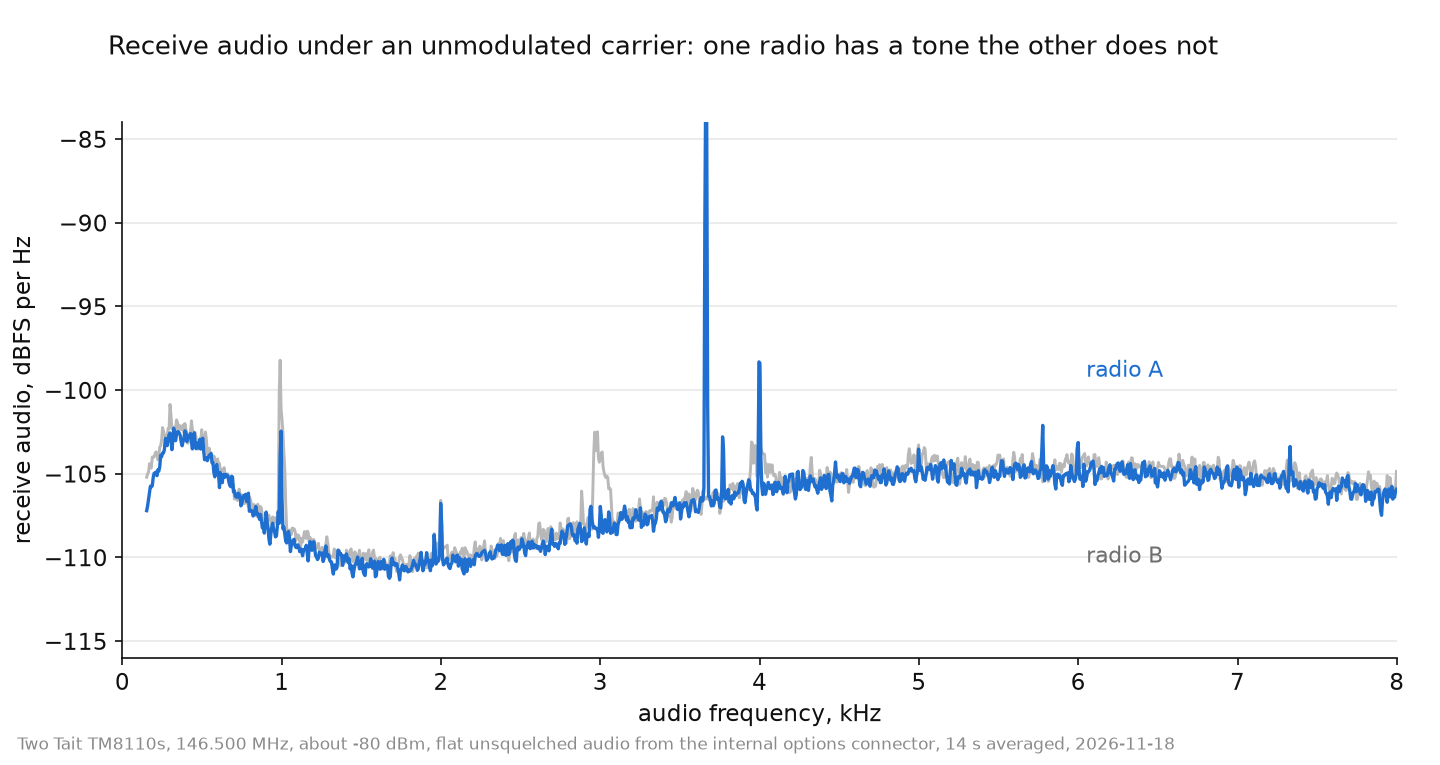
The audio is the radio’s flat, unsquelched receive tap, with no de-emphasis and no speaker filtering, at a signal of about -80 dBm. The tone stands 21 to 22 dB above the noise in a 23 Hz slice, which is what a tone of about 16 Hz deviation on the incoming signal would do. It shows whenever a carrier quiets the receiver; with no signal it is buried in the noise. The small lines at exact multiples of 1 kHz, on both radios, are USB pickup on the sound card board and not the radio.
| Radio | Tone | Level above the noise around it |
|---|---|---|
| The first one (since replaced) | 3.88 to 4.05 kHz | 23 to 26 dB |
| Radio A (its replacement) | 3.5 to 3.9 kHz | 21 to 22 dB |
| Radio B | about 3.6 kHz, and another near 1.2 kHz | 2 to 5 dB, and 7 to 9 dB |
Nobody using these for voice is likely to have noticed. It is 45 dB below full deviation and above the 3 kHz where a voice radio’s speaker audio normally ends, though I have not measured it at the speaker.
What it is not
My first guess was the usual kind of birdie: a harmonic of some internal clock landing near the channel, received like any other signal. It is not that.
- It is on every channel. Nine channels from 146.000 to 146.550 MHz, some picked to move or remove a clock harmonic, and the tone was there on all of them at the same level. Changing channel does not avoid it.
- It is not received. It stays a few hertz wide while the radio is receiving a fully modulated signal. A second carrier beating with the first would be smeared across kilohertz by the modulation.
- It is in the receive path only. An SDR listening to that radio’s own transmitted carrier finds nothing there.
- It is not the sound card board, the supply or the programming lead. It stayed with the radio when I swapped the boards, and it was the same on a battery and with the lead unplugged.
It is a thermometer
The tone never sits still, and what moves it is the radio’s own temperature.
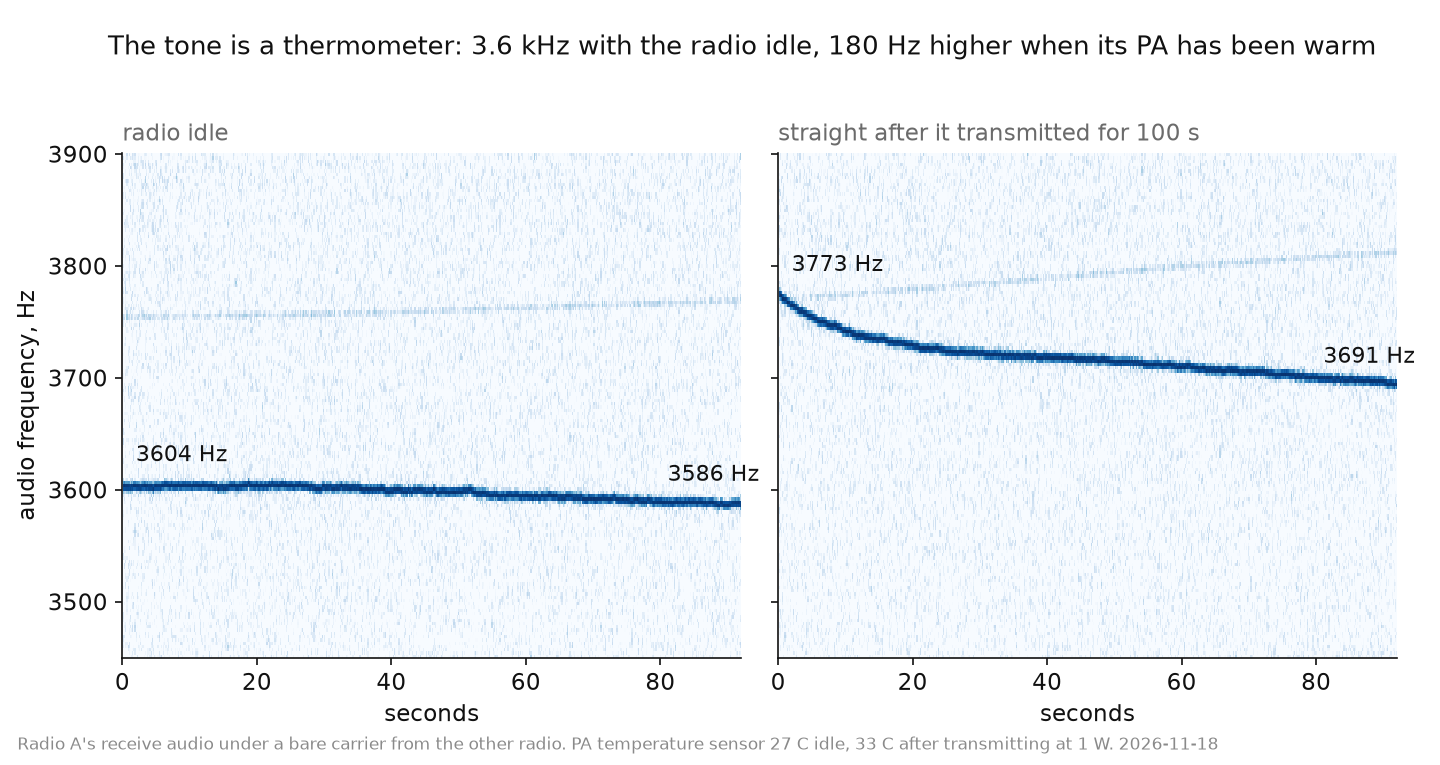
With the radio idle and its PA temperature sensor reading 27 degrees, the tone was at 3604 Hz. Straight after that radio had transmitted for 100 seconds at 1 W, with the sensor at 33 degrees, it was at 3773 Hz, and it slid back 80 Hz over the next minute and a half. That is about 30 Hz per degree on the PA sensor. Left alone in my room it sits near 3660 Hz.
Where it comes from
Tait’s service manual gives the receiver three frequencies:
- a 13.000 MHz reference, temperature compensated;
- a 13.012 MHz oscillator locked to that reference;
- a separate 12.288 MHz system clock for the digital board, which produces the receive audio at 48 kHz.
12.288 MHz is 256 times 48 kHz. And 13.012 MHz, seen by anything sampling at 48 kHz, lands on exactly 4.000 kHz, because 271 times 48 kHz is 13.008 MHz. So if a little of the 13.012 MHz oscillator gets into the audio conversion, it comes out as a 4 kHz tone.
It also explains the thermometer. The 13.012 MHz side is locked to a compensated reference and stays put. The system clock evidently is not compensated, and every part per million it moves shifts the tone by 13 Hz. The tone is the system clock’s error, magnified. A tone at 3660 Hz says the system clock is 26 ppm fast, and the 170 Hz rise after transmitting says it slowed by 13 ppm as the radio warmed.
The frequencies are Tait’s. The arithmetic and the conclusion are mine, but there is an experiment that backs them.
Tait’s birdie killer
Tait’s programming software has a per-channel tickbox called “Activate Birdie Killer”, for “a hum or whistle on a channel caused by internal interference”, and the service manual’s block diagram shows a line of that name going to the system clock. So the setting shifts the system clock slightly. If the tone is what I think it is, the setting should move the tone, and by a predictable amount.
It does:
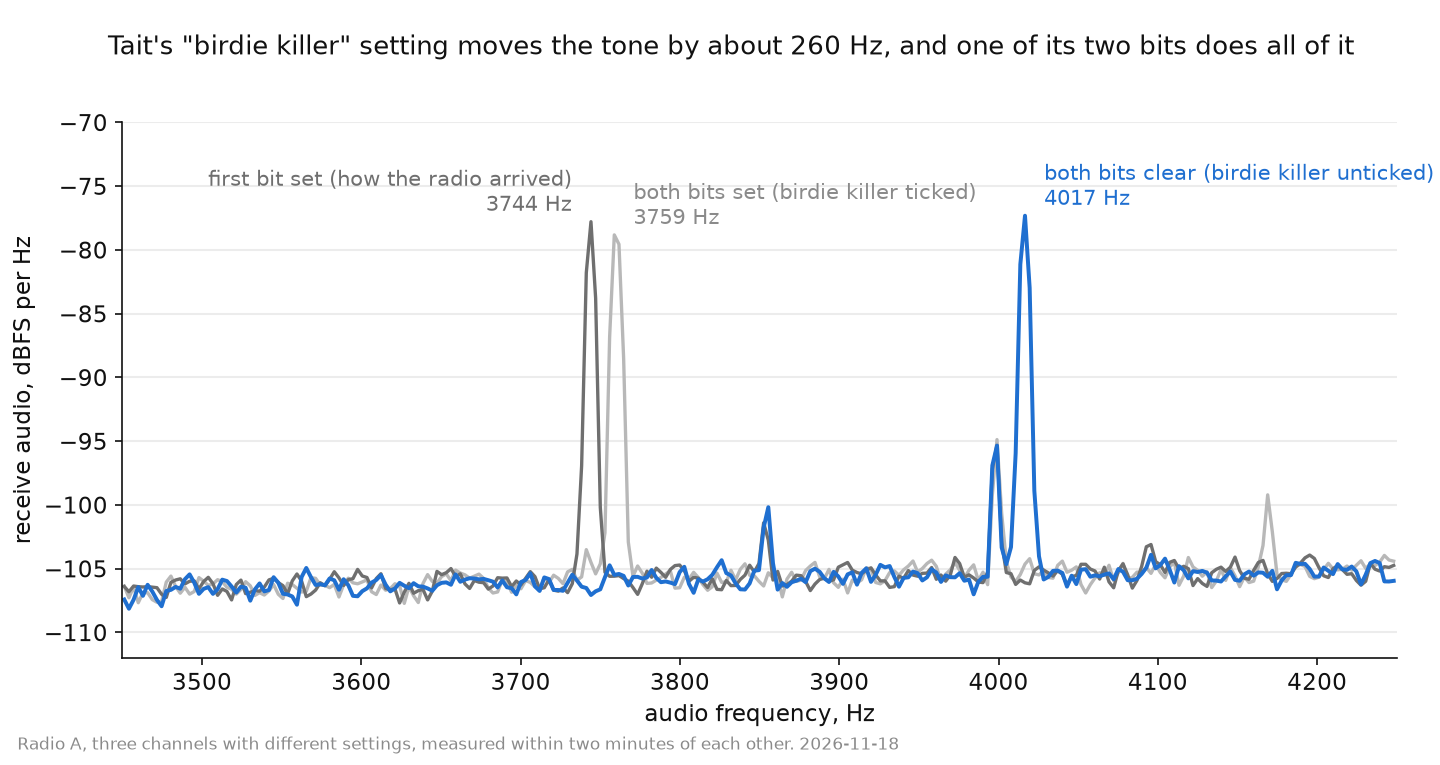
| Channel setting | Tone |
|---|---|
| Birdie killer off | 4.00 to 4.02 kHz |
| First bit only (how both my radios arrived) | 3.69 to 3.74 kHz |
| Birdie killer on (both bits) | 3.74 to 3.76 kHz |
With the setting off the tone sits within 20 Hz of 4.000 kHz at room temperature, which is where the arithmetic puts it when the system clock is on frequency. With it on, the clock runs about 20 ppm fast and the tone drops by about 260 Hz.
So the birdie killer does not kill this birdie. My reading is that it was meant for the ordinary kind, a harmonic of the system clock landing on a channel you want to listen to, where a 20 ppm shift moves the harmonic out of the way. This tone only moves.
In the codeplug the setting is the first two bits of each channel’s record. Only the first one moved anything I could measure. tait-codeplug now reads and writes it as ch<N>.birdiekiller (the change, in the next release). If you have used that tool’s splittx field, that was this bit under the wrong name, and it is gone.
What it costs
For voice, 1200 baud and 9600 baud I would expect nothing: the tone is 45 dB down. A wide OFDM signal is different, because it spreads its power over hundreds of carriers and each one is small.
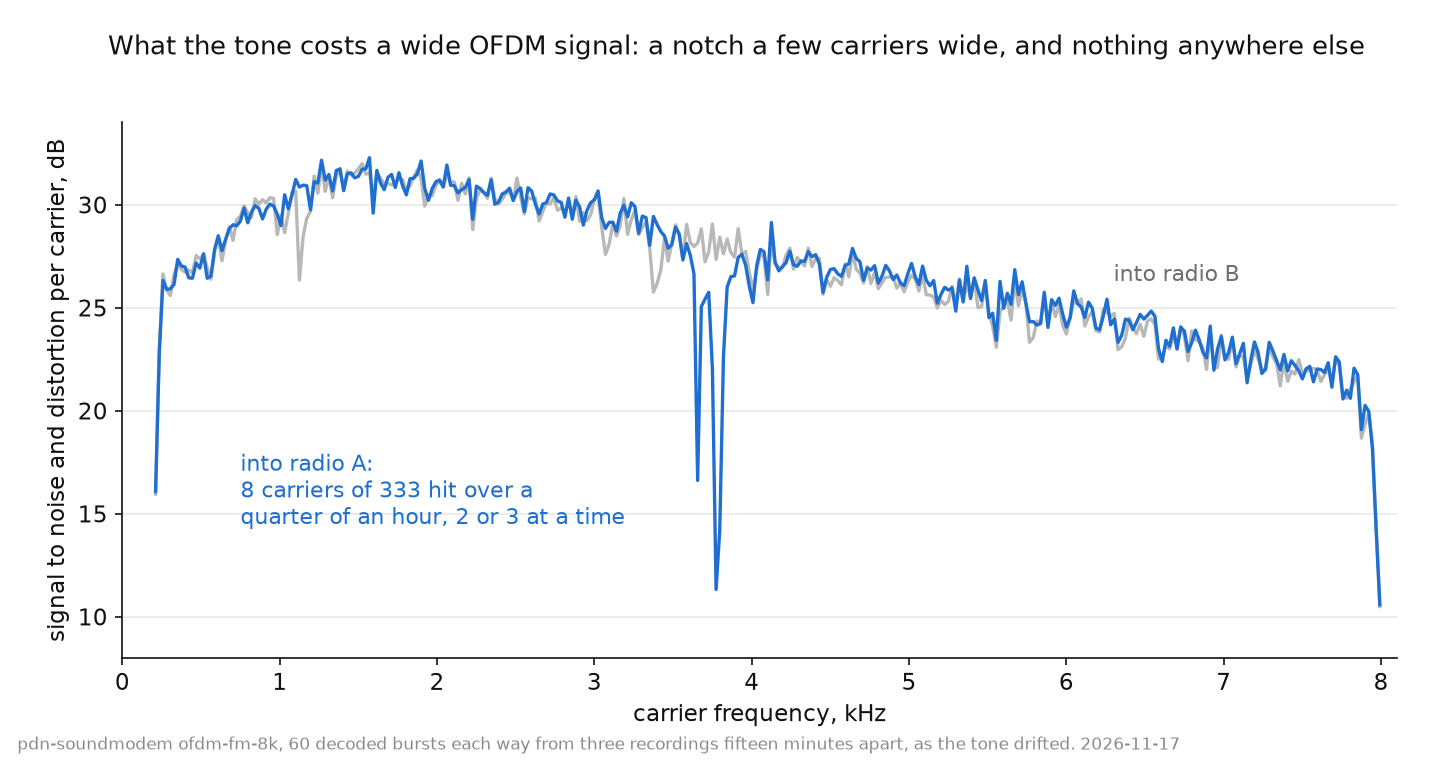
- Two or three carriers of 333 lose 10 to 16 dB. The rest are as good as the other radio’s.
- Which carriers changes as the radio warms and cools. Over a quarter of an hour it hit eight different ones. Within a single burst it moves by less than one.
- A notch filter is the wrong cure. It costs more carriers than the tone does, and the tone moves.
- A receiver that weights each carrier by the noise it actually sees loses about half a decibel. That is what pdn-soundmodem’s OFDM receiver now does (merged this week, not yet released).
Check your own
You need the radio’s flat receive audio (a discriminator or unfiltered tap, not the speaker) into a sound card, and a steady unmodulated signal strong enough to quiet the receiver: a second radio keyed into a dummy load with no audio will do. Record 15 seconds and look for narrow lines between 3 and 5 kHz.
My bench notes for these radios have a script that does the looking:
$ python3 wavan.py spurs q-top.wav
14.2 s of quiet carrier; noise -109.9 dBFS/Hz at 1 to 3 kHz, -106.0 at 3 to 5 kHz
    993.8 Hz   -93.4 dBFS   +1.6 dB over the noise in 23.4 Hz  about 1.3 Hz of deviation  9 Hz wide  a multiple of 1 kHz: USB frame-rate pickup on the board
   3663.6 Hz   -71.3 dBFS  +21.8 dB over the noise in 23.4 Hz  about 16.5 Hz of deviation  6 Hz wide  not a multiple of 1 kHz: made in the radio
   3999.4 Hz   -88.2 dBFS   +4.0 dB over the noise in 23.4 Hz  about 2.3 Hz of deviation  6 Hz wide  a multiple of 1 kHz: USB frame-rate pickup on the board
FAIL: a tone that is not the USB frame rate stands 21.8 dB over the noise in one carrier (limit 10)
Run it with the radio cold and again after it has transmitted for a while, since the tone moves. The small lines at exact multiples of 1 kHz are USB pickup on my sound card board, not the radio. The same notes have the measurements behind these figures, and the rest of what I have measured on these radios and boards.
What I don’t know
- How common it is. Three radios, all VHF TM8110s. I have not tried a TM8200 or a UHF one.
- Why one radio of three is so much better. Radio B’s tone near 3.6 kHz is 2 to 5 dB where the other two are over 20. It has a different one near 1.2 kHz that I have not explained.
- How the 13.012 MHz gets into the audio. I have the frequencies, not the path.
- The second line. The spectrograms above show a much fainter tone nearby that drifts the other way. I have no explanation for it.
If you have one of these radios with flat audio out, I would like to know what yours does. An issue on the bench notes repository will reach me.